
That time Spawn blundered into a domestic crisis
Things got topical in Todd McFarlane and Greg Capullo's Very Special Issue.

This is RETROGRADING, where it’s time you learned another lesson… like DYING!
THE COMIC: Spawn #29: “Father”
THE YEAR: 1995. “Gangsta’s Paradise” hit the radio and Die Hard With a Vengeance yippee-kay-yayed into theaters as the comics speculator boom Image Comics rode to dominance began to crest. Yet Spawn was still riding high as one of the decade’s biggest series, only a few years into its record-shattering, still ongoing 300+ issue run.
THE SPECS: Written by Todd McFarlane; art by Greg Capullo and McFarlane; colored by Steve Oliff & Olyoptics; lettered by Tom Orzechowski; published by Image Comics.
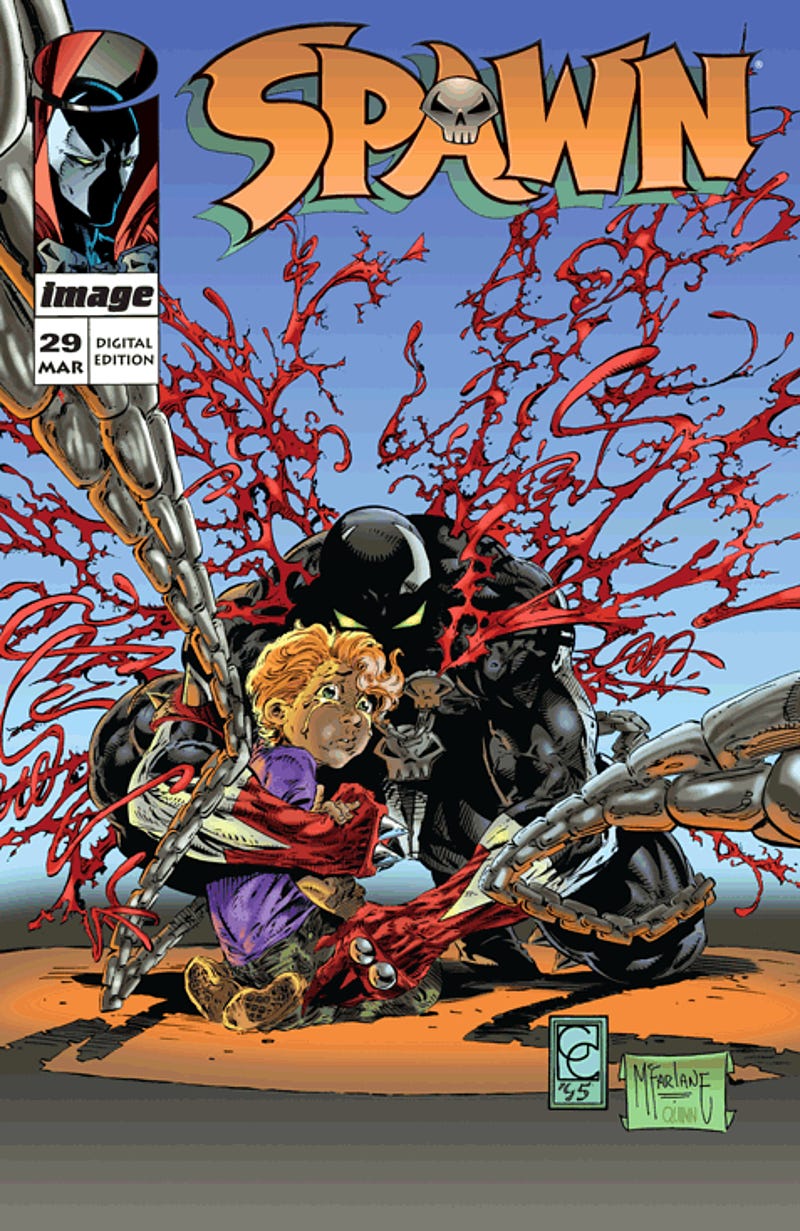
THE MAKE: Spawn was the ultimate Nineties antihero: a murdered government assassin named Al Simmons, back from Hell and out for vengeance. Festooned in spikes and chains, and tormented by his pact with the devil Malebolgia and his separation from his wife, Spawn delivered hyperviolent justice to smart-ass demons and human monsters alike. There was no stately manor or fortress of solitude for him; Al’s dwelling was a maze of New York City alleyways among society’s other outcasts. His comics series was a bestseller, his action figures were the coolest, his adult-oriented HBO cartoon was groundbreaking, and the inevitable live-action movie was… well, lousy.
Before all this, Spawn was born in Todd McFarlane’s high school sketchbooks. In the documentary Todd McFarlane: Like Hell I Won’t, the media mogul explains that growing up in blue-collar Canada, his dream of drawing comics professionally seemed impossible. McFarlane was tenacious; he studied art while attending college on a baseball scholarship, and when a busted ankle dashed his chances of going pro, he bet everything on his drawing hand. He sent out hundreds of art samples before eventually breaking into the big leagues at Marvel and DC. Following stints on Detective Comics and Incredible Hulk, it was his work on The Amazing Spider-Man — where he co-created the antihero Venom — that made McFarlane a superstar. His hyper-detailed art was moody and bouncy at the same time, which revolutionized Spider-Man’s iconic look with big eyes, outlandish poses, and spaghetti webbing. Marvel editorial hated his style, and fans couldn’t get enough of it.
Eventually, Marvel bowed to McFarlane’s demands for more creative control and gave him a book to write and draw himself, titled simply Spider-Man. Critics slammed the writing as incoherent, amateurish, and excessively dark for a lighthearted hero, but McFarlane’s idiosyncratic vein of edgy superhero horror appealed to legions of teenage and prepubescent readers. The first issue sold over two million copies. Then, in 1992, McFarlane and six of Marvel’s other top artists walked away to form Image Comics, a company where creators own, control, and reap the financial benefits of their creations. It was a daring rebuke to business-as-usual in the comics industry. McFarlane had become a firebrand evangelist for creator control.
Image became the market’s third-largest publisher almost overnight, and Spawn was its biggest hit. But as McFarlane launched a toy company and worked to adapt Spawn into other media, those business responsibilities cut into his writing and drawing duties. After bringing on a few high-profile guest writers, including Frank Miller and Alan Moore, he returned to scripting and stepped back from the drawing board, poaching artist Greg Capullo from Marvel’s X-Force. Capullo came on board to pencil Spawn #16-20 and, beginning with #26, took the reins as the regular artist, going on to draw more issues of Spawn than any other artist. Spawn #29 found Capullo still settling in and its creator beginning to toy with the limits of what an Al Simmons story could be.
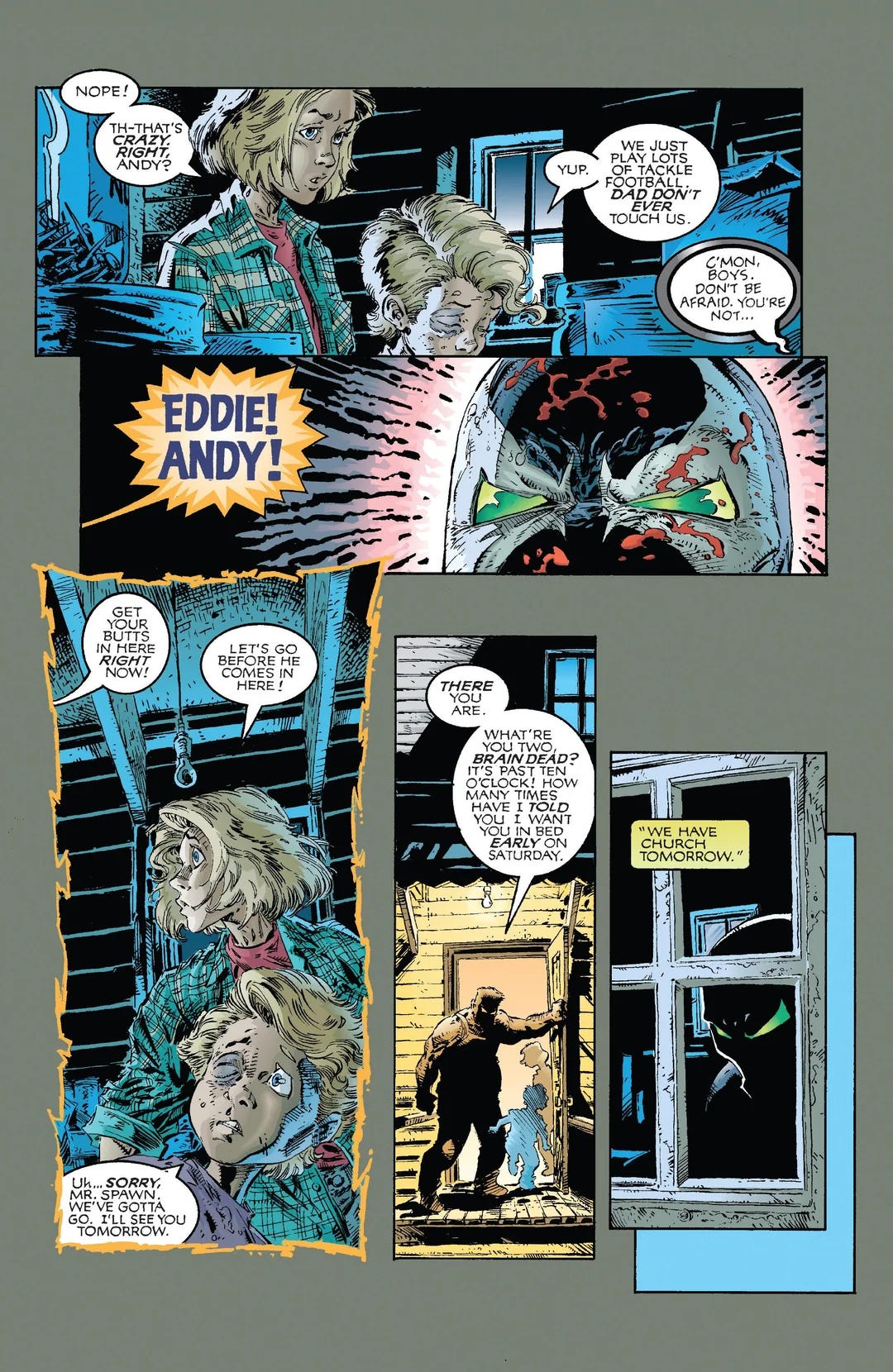
THE REVIEW: “Father” opens in a small town in Alabama, where Spawn, battered and barely conscious after his battle in Heaven, lies broken and spent. (Events that took place in the Angela miniseries, illustrated by Capullo! — Ed.) His costume, a living, symbiotic hell-shroud, is also injured, its enormous, billowing cape reduced to squirming threads. As fate would have it, a young boy named Andy Frank finds Al lying on the sidewalk and, excited to have found a superhero friend, drags Spawn home in his wagon (with some assistance from the costume’s chains). It’s an endearingly funny image that’s soon undercut by a stomach-churning glimpse of welts and bruises beneath Andy’s shirt. Soon we meet the boy’s protective older brother, Eddie, and their abusive drunk of a father. The elder Frank is the local Sheriff, shielded by his badge and status in the church-going community.
McFarlane’s revulsion at child abuse drives the story. Two of his Spider-Man stories featured young victims, and Spawn #5, the book’s first hotly controversial issue, ended with Spawn brutally executing the serial child killer Billy Kincaid. This fascination with society’s dark underbelly, combined with the character’s outrageous backstory and traits, often leads to Spawn being labeled dumb edgelord fare. It’s a valid critique, but it misses the point. Undoubtedly, the series is often dimmer than its ambitions, but readers who devoured it in the mid-Nineties appreciated comics like Spawn that faced the world’s evils head-on, even if the execution was, in true McFarlane style, messy. That’s what Spawn was in its prime: a grimy dose of reality spliced with the macho action and macabre chills people sought at Blockbuster Video.
“Father” doesn’t quite deliver that punch; Spawn’s trademark monsters and ginormous guns are absent, leaving this tale short on the series’ visual flair. Still, Capullo and McFarlane tackle the grounded material with their signature showmanship, coating these pages with the gritty, forbidding textures and barbed edges that made them famous. Capullo also brought artistic chops to Spawn that McFarlane otherwise lacked, namely a command of perspective, proportion, and suspense, which lends weight to this issue’s harrowing depictions of domestic abuse. But nailing social realism or nuance was neither of the creators’ strong suits. A story about child abuse from the victims’ perspective is tricky enough to pull off on its own, and the ominousness of a hellspawn hiding in their shed like an ersatz E.T. introduces dissonance that the creative team never quite resolves.
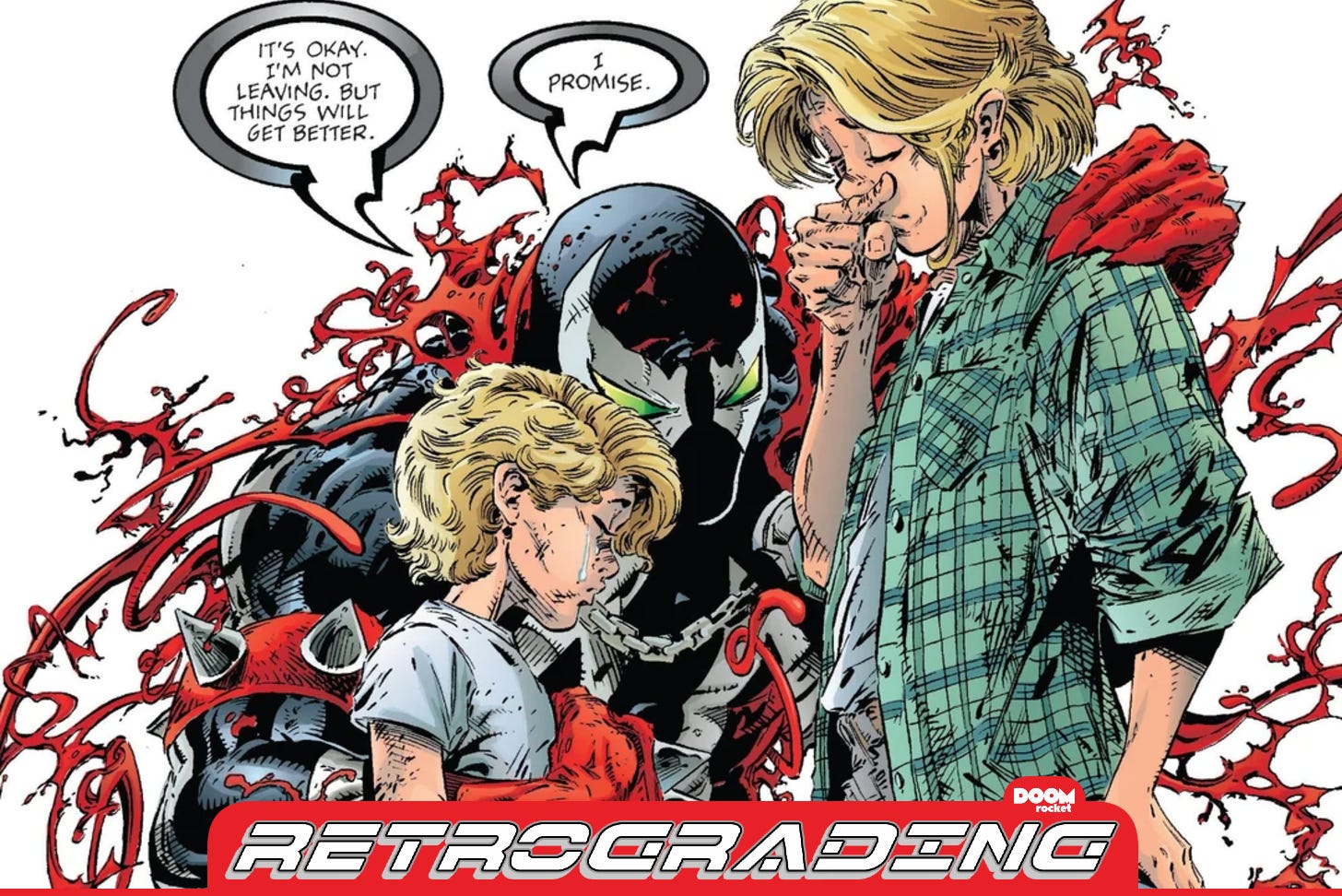
A splash page of Spawn comforting the boys is touching, in spite of or because of these contrasts. In McFarlane’s world, when family, the law, and the church have all failed, the only friend children can hope for is a demonic killer in a gnarly costume. But the effect is marred by a clunky dramatic choice late in the issue: Spawn says he won’t leave the boys, only to inevitably leave them. This fumbled attempt at poignancy robs McFarlane’s story of its full potential. A few series-dependent subplots also drag the story down. A scene featuring Spawn’s former wife, Wanda, and her new family’s happiness offers deliberate contrast to Andy and Eddie’s miserable home life, and Detectives Sam and Twitch get close to nailing their boss for his involvement in the Billy Kincaid cover-up. The thematic resonances are obvious and distract from the story being told here.
Before departing, Spawn exacts his vengeance, covering Sheriff Frank with mystical tattoos that state his heinous guilt, telling him they’ll fade with good behavior. But Spawn’s ill-considered intervention only sparks another violent outburst. Fearing for his brother’s life, Eddie kills his father with his own revolver, which, in proper Chekhovian fashion, has hung around since Act One. In a rare moment of restraint, McFarlane doesn’t show the kill or its aftermath, ending instead with a silhouette of the Frank household against a red sky, the panel shaped in the onomatopoeic BLAM. It ain’t subtle, but it is chilling. There are no easy answers here; whatever the series’ flaws, Spawn doesn’t pretend there are.
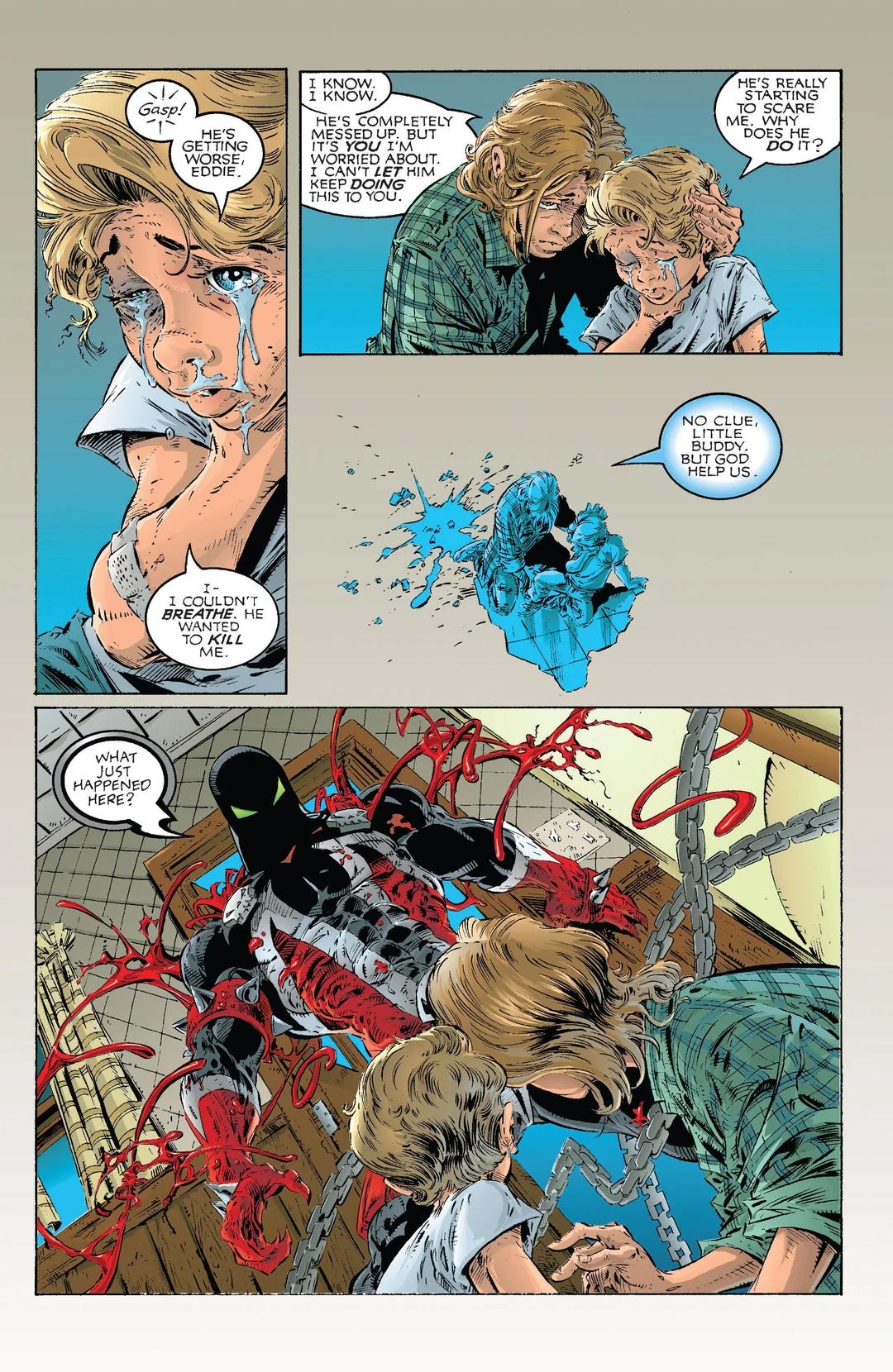
NOSTALGIA-FEST OR REPRESSED NIGHTMARE? “Father” doesn’t reach the rooftop-brooding, demon-dismembering heights of peak Spawn, but it’s a decent piece of kitchen-sink horror that leaves a lingering sting.
RETROGRADE: C+
 | A guest post by
|
Great write-up on such a massively popular, eternally strange series.