

CHAPTER 51
Chapter 51 is a mock documentary, a fake-movie murder mystery, a serial-killer comedy, and I don’t even know what else. I do know that it sits at the nexus of arthouse pretension and Hitchcockian gooner schlock; it’s silly, nimble, pretty to look at, obnoxious, and exhausting. It’s also funny. Every so often, in its feverish, inside-Hollyweird hurly-burly, it damn near transcends those pretensions and stumbles into something that feels, dare I say, unique. Think a student-film crack at L.A. Confidential smushed with Errol Morris’s Thin Blue Line and Michael Hoffman’s Soapdish, directed by McG in a Wes Anderson wig, and you’re nearly there.
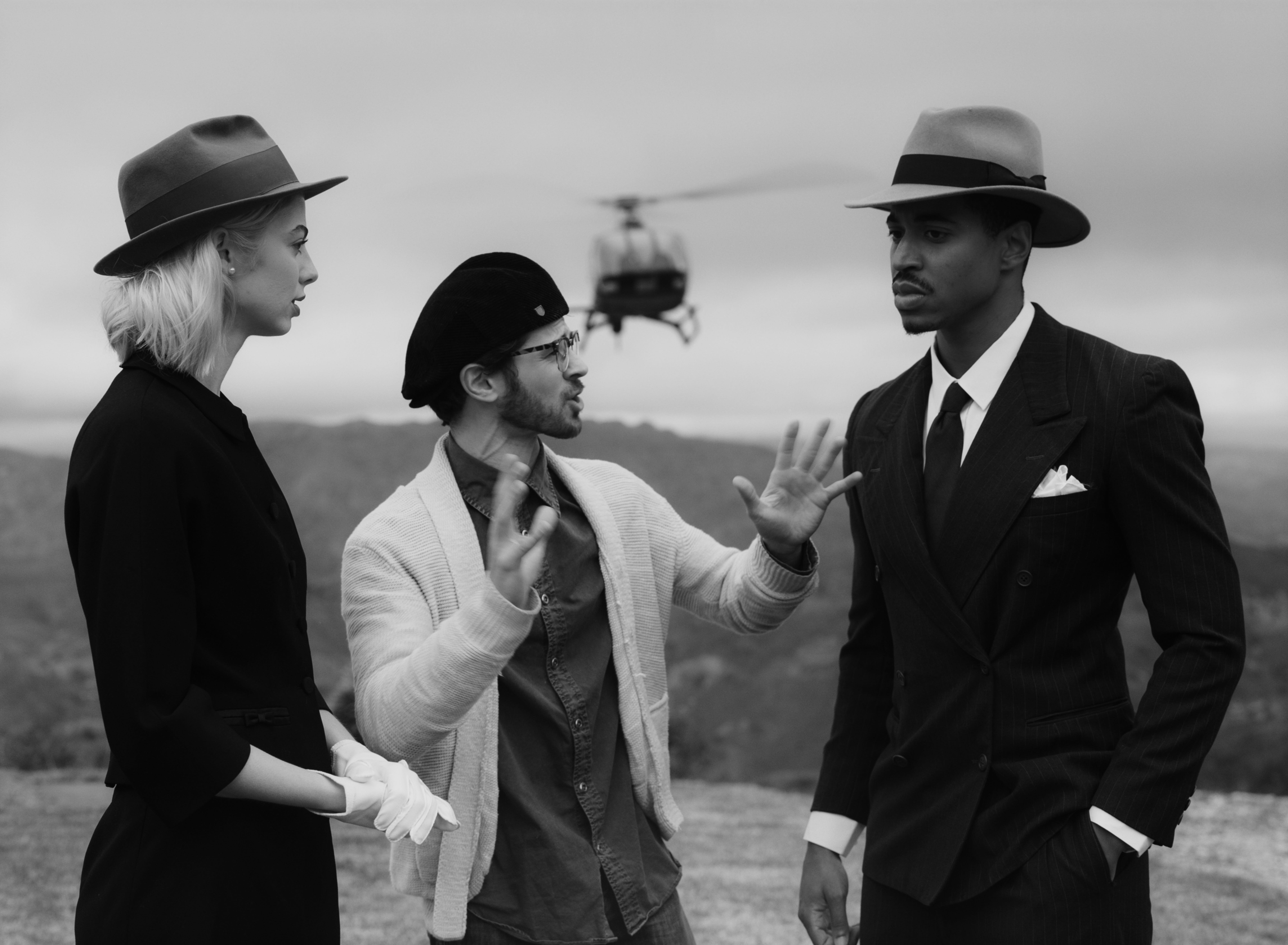
Whether that particular cocktail proves intoxicating depends almost entirely on your tolerance for the film’s camera-dork obsessiveness. Its director, photographer Tyler Shields — who also stars as the narrator — knows how to compose a crackerjack shot. He is also pathologically devoted to film stock, aspect ratios, and lenses. IMAX, Panavision, VistaVision, and Technicolor; Kodak 8mm, 16mm, 35mm, and 65mm; even an anamorphic IMAX lens custom-built for this film by Panavision: the true function of Chapter 51 — one that Shields may prefer people consider it to be, beyond, y’know, being a movie — is an exhibition of every bleeding-edge way light can filter through celluloid. His technical fetishism smothers his story.
Shields’s ambition also infects his characters, but in a good way. Chapter 51 is a jigsaw configuration that attempts, and not in vain, to chronicle the doomed production of Dissident, “the most controversial film” in history. It’s an irresistible premise: a purportedly groundbreaking yet troubled project ignites a civil war between its screenwriter and director, with producers, cast, and crew choosing sides (or otherwise grinning through the chaos) before the director, Demy, walks off the project altogether and is replaced by his hated artistic foil. Demy is played by Colman Domingo, who gives the director an air of fatigue that many viewers may eventually sympathize with, despite how much fun some of these characters are.
His nemesis is Pace (Connor Paolo), a tightly wound usurper cloned from the messy leavings of Quentin Tarantino, Max Landis, and a rabid chihuahua. “It’s some obscure DGA law: you’re not supposed to fuckin’ kick the shit out of the director,” he says in one of the countless outtakes that assemble into the film’s elliptical narrative structure. The story behind that: Demy insisted the cameras never stop rolling, driving certain producers of the film bananas — perhaps even to murder. Pace inherits the practice, and so the cameras keep rolling, capturing all that transpires behind the scenes of Dissident, including credible motives for the production’s innumerable murder suspects.
This brings us to the three doomed actresses cast as Dissident’s femme fatale, all of whom are knocked off during production by what the media dubs “The Hollywood Killer.” Shields, convincingly bland as the FBI agent who guides us through this comic seediness, marshals a parade of suspects to suss out THK’s identity and comes up with no shortage of scoundrels and villains who fit the bill.
The mystery itself is less compelling than the sneering egomaniacs who populate it, and Shields seems aware of this. One of the better recurring bits is Pace hurling invective at his hollow-eyed male lead, Dustin Scott, who wears an expression that suggests he yearns for a quick death. (Dylan Sprayberry, as Dustin, has one of the best hangdog mugs around.) One delightfully extraneous narrative cul-de-sac involves the troubled, Brando-esque actor Lawrence Hughes, played at a tragic/lunatic register by Logan Huffman. In a stacked whodunit like this, Hughes stands out, and his early departure from the film creates a charisma void that Chapter 51 attempts to fill with its Swiss cheese plot, visual busywork, and a stupefying amount of immaculate b-roll. Shields’s indulgences pile up to the point that his cameras get top billing.
6 / 10
Chapter 51 is available on digital now. For more info, click this.
Written and directed by Tyler Shields.
Starring Connor Paolo, Colman Domingo, Dylan Sprayberry, Abigail Breslin, Logan Huffman, and Allie Marie Evans.
97 mins. / Unrated. The cameras capture withering bon mots and a bit of murder.
NIGHT AFTER NIGHT
Night After Night is a paranoid creeper that reveres atmosphere above all else, and not always to its benefit. Director Josh Lobo has clearly nailed the grammar of digital filmmaking: even on what appears to be a modest budget, his film often looks quite legit, all razor-edged cuts, crisp contrasts, and deep pools of velvety black. Between this and his debut, I Trapped the Devil (2019), I’d say he comes off as a filmmaker well-fed on a diet of speculative fiction and metaphysical horror. But sci-fi/horror demands more than discipline; the finest examples unsettle the nerves because they’ve first engaged the brain, and their tension derives from a human element generating friction within the machinery. The other option, of course, is to create a visual/sensual experience so overwhelming that watching it leaves the viewer in a drooling heap.
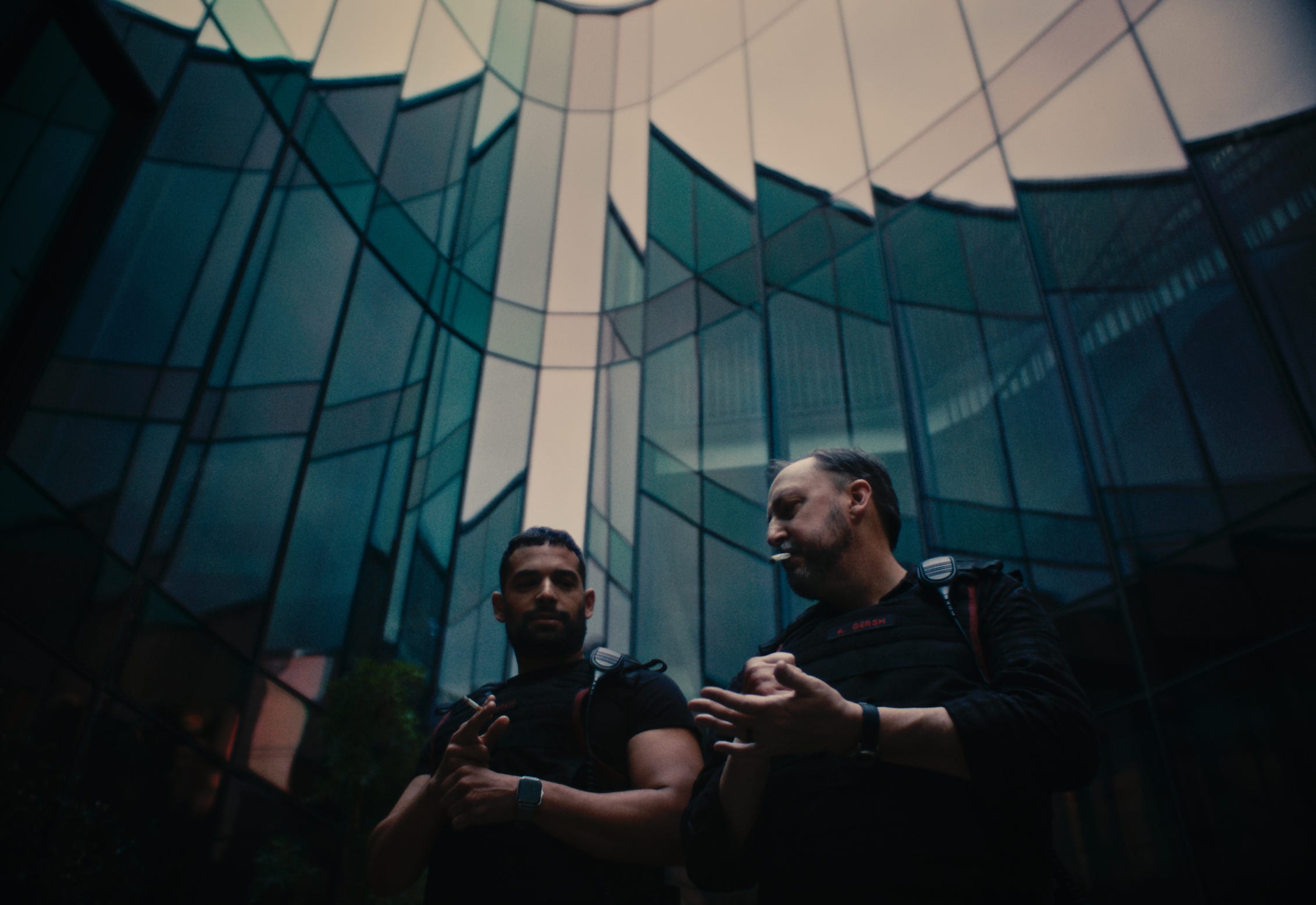
Lobo attempts both. Night After Night adopts a cerebral approach and an almost anthropological remove from its characters, chronicling its themes of paranoia as if observed through a one-way mirror. The film follows Andy (Scott Poythress), a security careerist who accepts a position at an elite private university that some beyond its gates insist is a cult. Andy is your typical acolyte from the Terry Gilliam school of existentialism and alienation: estranged from a home life the film pointedly withholds, he spends his off-hours in a dingy hotel, gazing into the middle distance. He scarcely opens up to his partner, Willis (Johnny Sibilly), except to confess that television suits him better than movies because movies are “too subliminal.” Cheeky.
As Andy gradually warms to him, Willis retreats into a morbid funk, musing about organ damage from a 35mm bullet and other alarming conversational dead ends. Meanwhile, Andy makes time to gawk at his family home and call his long-suffering wife, only to hang up on her pleas for reconciliation. If this all seems more monotonous than intriguing, that’s because Lobo is so laser-focused on establishing a mood that he accidentally lets his suspense go slack.
The hook starts dangling once Andy is instructed — not asked — to sit on guard at night as construction at the university nears completion. Just as we learn Willis has vanished, the narrative doubles back, shifting perspective to reveal what transpired during Willis’s night shifts. We meet his romantic partner, glimpse a lively social life, and understand that his earlier personality shift wasn’t a matter of temperament but perhaps contamination. Of what? I’d direct you to scan the ensuing nocturnal discoveries inside the university itself, because after watching the film in its entirety, I have absolutely zero clue.
Night After Night fractures twice more into a chaptered structure that promises each new perspective will peel away another layer of meaning. No such luck. Working with co-writer Rowan Russell, Lobo interlocks the character threads with admirable coherence — the world feels inhabited in ways these self-consciously enigmatic jobs so often don’t — but the frights remain stubbornly, maddeningly, theoretical. Distortion, shock edits, and a parade of disquieting full frontal drift across the screen with immaculate composure and little resonance. The film is so devoted to creating a chill that it forgets to crank up the temperature to get the blood pumping. Still, I remain excited to see what Lobo gets up to next. His eye is already sharp; what he needs now is to let some messy humanity stain the pristine surfaces of his murk machine.
5 / 10
Night After Night screened at the Chattanooga Film Festival on June 18. For more info, click this.
Directed by Josh Lobo.
Written by Josh Lobo and Rowan Russell.
Starring Scott Poythress, Johnny Sibilly, Alexis Louder, AJ Bowen, and Trace Lysette.
98 mins. / Unrated. Andy encounters dangly bits in spaces you might not expect.
LOCKBOX
Lockbox is lurid, trashy schlock that commits the sin of taking itself seriously. That’s a shame, because it also commits somewhat to its lunatic premise, going for broke in a way more sensible filmmakers would cautiously suppress. For a story about a creeping, predatory evil invading young minds made vulnerable over a lifetime of abuse, you might expect a certain amount of discretion, a compulsion to avert our gaze from its ugliest details. Instead, here’s an MGM+ Original production presenting awful, vile things that make you go, “ewww.”
Directed by Daniel Stamm and written by Justin Yoffe and Soren Narnia, Lockbox adapts one of Narnia’s stories from his Knifepoint horror podcast. Along the way, the team makes a few dubious creative decisions — but before getting to those, it’s worth digging into how this bizarre contraption works.
So, the story. We meet Ellen Hershbergen (Carla Gugino), a former fashion designer and children’s book author, and, most recently, the caretaker of her recently deceased mother. Why she gives us the full résumé is anyone’s guess, though the children’s author/caretaker combo efficiently telegraphs a kindness and inexhaustible patience that Gugino conveys with natural ease. Left alone in a house that’s suddenly too big and Ellen fresh out of people to please, fate intercedes with a call from a distant relative asking if her grown-up cousin, Winthrop (Lou Taylor Pucci), a recently discharged veteran, might stay with her while he readjusts to civilian life. Ellen, who hugs nearly everyone she encounters, agrees before the request has finished. Of course, Winthrop can stay. Oh, he has severe PTSD and recoils from physical affection? Well, that complicates things.
Still, Ellen welcomes Winthrop with unwavering respect, becoming as much his caregiver as his roommate. The film, meanwhile, wastes little time establishing him as its first monster, confronting us with his graphic, violent fantasies and, later, the spectacle of Winthrop viciously assaulting people while dressed in drag. More on that in a moment. The catalyst for this emotional unraveling is Vahna (Katharine Isabelle), a squirrelly New Age drifter who materializes in Ellen’s life from parts unknown and all but moves into the house. Their odd-couple dynamic is broadly sketched — she chugs wine while Ellen politely sips, etc. — while only faintly teasing the psychosexual tension between them that might have pushed Lockbox into the full-blooded exploitation movie it can only gesture toward. And Ellen, legally incapable of refusing anyone, welcomes Vahna despite the obvious distress she causes her increasingly jittery cousin.
From here, mild spoilers. The first real fissure in Ellen’s otherwise pleasant domestic life arrives with Vahna’s sudden, violent death, leaving Winthrop as the obvious suspect. Soon, he begins exhibiting personality traits once associated with a certain crunchy mooch who recently slipped this mortal coil. What exactly is happening? And what, for that matter, does “Lockbox” mean? Stamm and his writers eventually supply answers, but only after belaboring the hideous details of the evil they’ve cooked up — what it’s done and what it’s still capable of.
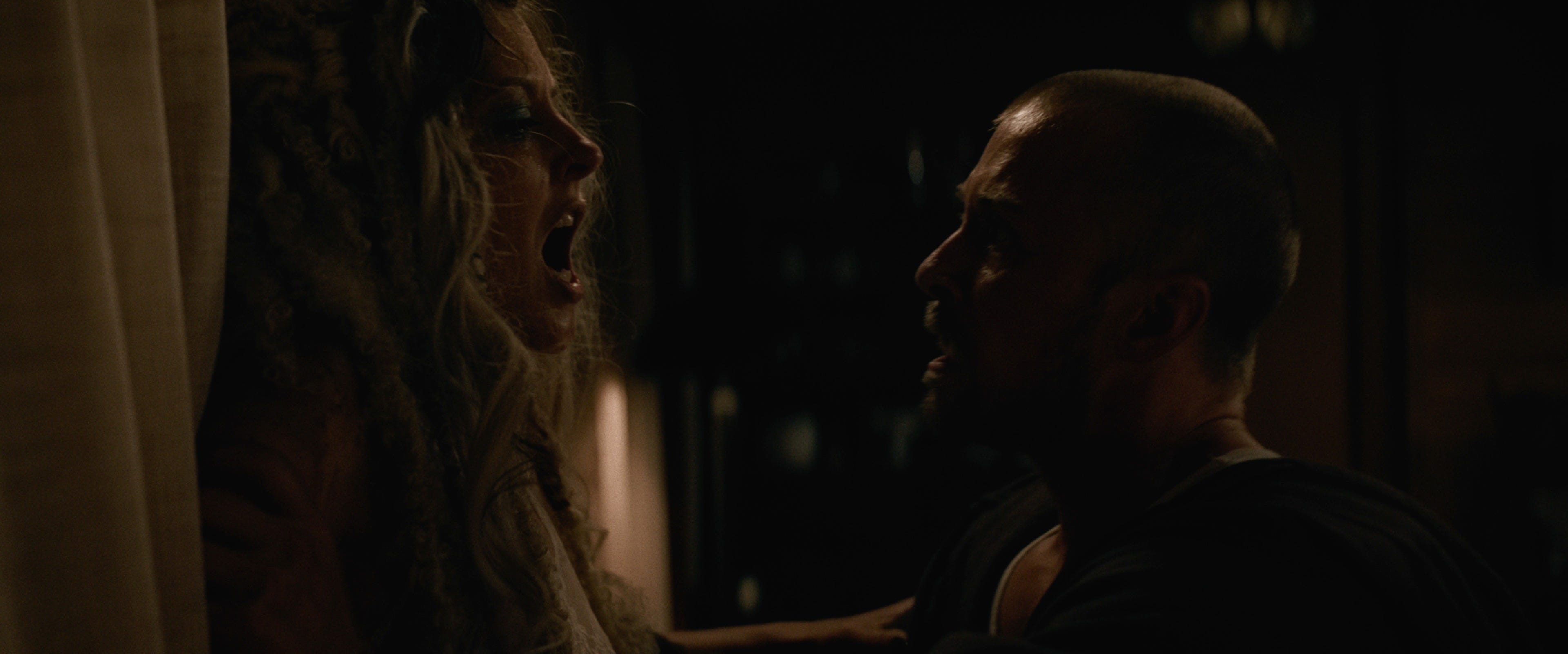
And those dubious choices? The matter of Winthrop’s transformation into a homicidal crossdresser — a development the film carefully avoids categorizing, which feels like a cheap precaution meant to somehow excuse its implications — is compounded by a secret religious sect determined to extract whatever has possessed him. Later, they introduce a deeply traumatized child whom these pious types use like a psychic landfill for unfathomable evil. What this eventually says about Winthrop’s suffering, and the peculiar logic by which the film resolves it, is at least kind of neat. Ellen pushes past her niceties and enters the abyss, where Gugino gets to play with practical flesh-ripping effects that evoke gnarly memories of Gerald’s Game.
The problem is that Stamm plays it all completely straight, hitting the bog-standard trauma-horror notes (even lighting his movie so dimly it becomes a trial to watch) without irony or reflection. These characters are stock, not people, though Gugino and Pucci manage to carve out a surprisingly touching found-family dynamic anyway. That tension — between the movie’s welcome exploitation trashiness and its frustrating lack of self-awareness — defines Lockbox. It’s eminently watchable junk that makes you frown at its carelessness before making one last attempt to lift your spirits. You’ll probably keep frowning.
4 / 10
Lockbox is in select theaters now. For more info, click this.
Directed by Daniel Stamm.
Written by Soren Narnia and Justin Yoffe.
Starring Carla Gugino, Lou Taylor Pucci, and Katharine Isabella.
105 mins. / Unrated. Includes troubling discussions of child abuse.